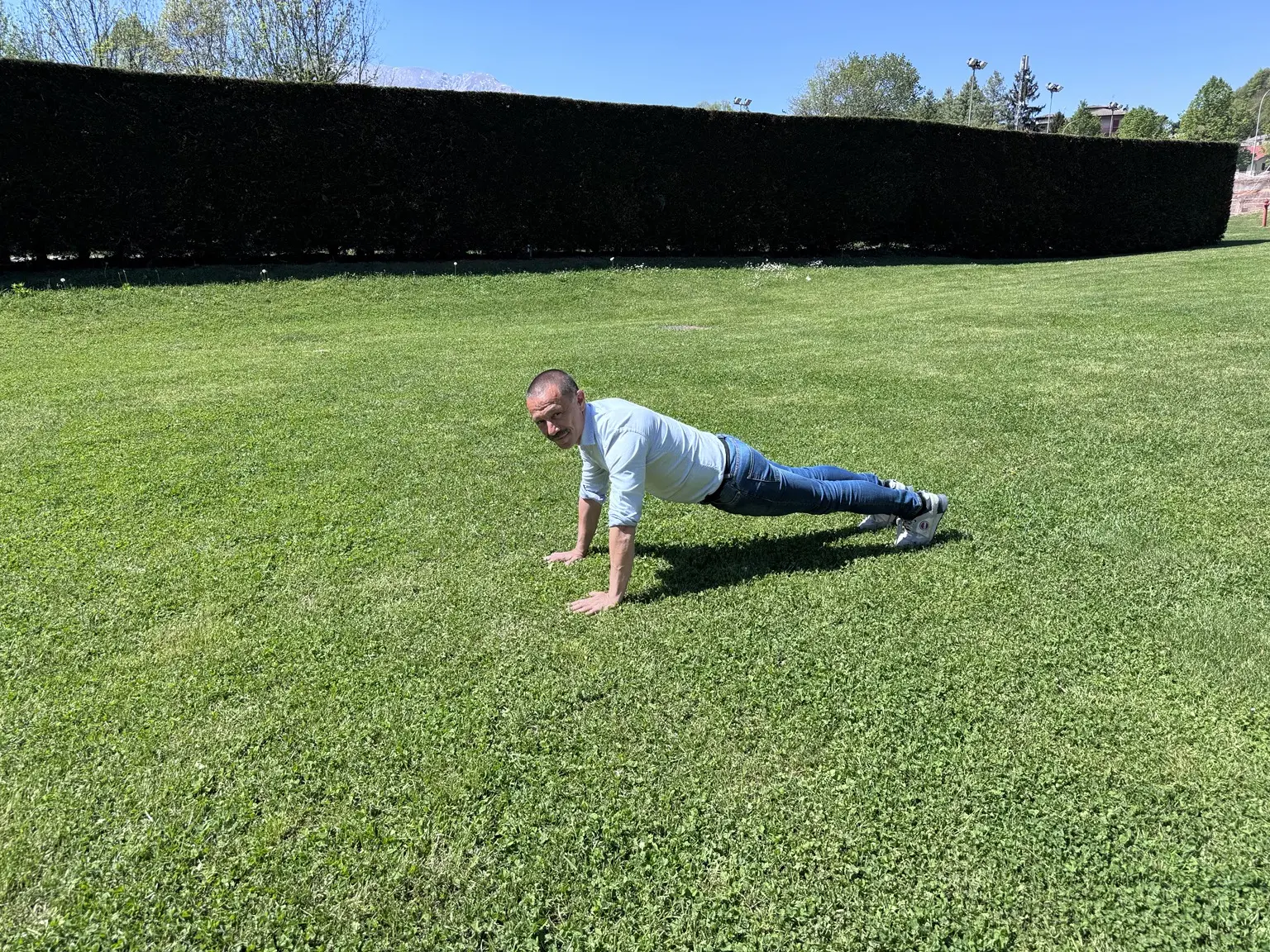
The straight-arm journey did not begin from nowhere. It grew out of months spent learning another version of the same challenge, one memorable conversation and a suggestion from a Hungarian friend that changed the direction of my training.
Before straight arms
In 2025, I dedicated several months to the forearm plank. What began as a simple exercise gradually became an endurance project, and I eventually reached a personal best of twenty-seven minutes.
That period taught me how slowly time moves inside an isometric hold, how the mind negotiates discomfort and how much progress can come from returning to the same simple position with consistency.
A conversation with Josef Šálek
In January 2026, I had the pleasure of speaking with Josef Šálek, the forearm-plank world-record holder. Talking directly with someone who had taken the discipline to its highest level made the idea of a record feel less abstract.
It did not make the challenge smaller. It made the path more real: behind an extraordinary time there is an ordinary sequence of training days, decisions, fatigue and persistence.
The spark
In April 2026, my Hungarian friend Zsolt told me about the straight-arm plank. I had spent months focused on the forearm version, but this was a different challenge and I wanted to understand it for myself.
The elbows remain extended, the hands take the load and the shoulders must stay active for the entire duration. It is visually simple and physically uncompromising. I tried it—and the timer reached twelve minutes.
That first result did not answer a question. It created one. The spark was immediate: how far could a structured process take me in this new discipline?
What twelve minutes meant
Twelve minutes was not a world-class performance. It was, however, enough to reveal an unusual starting point and to make a much larger objective feel worth investigating.
The important shift was mental. Instead of asking whether I could tolerate the position, I began asking how far a structured process could take me.
From an attempt to a project
The numbers moved from twelve to sixteen and then eighteen minutes. Around them grew an entire method: split volume, continuous holds, recovery days, respiratory control, attention to numbness and the decision not to turn every session into a test.
One More Minute begins here—not with the world record, but with the moment a first attempt became a direction.
THE TAKEAWAYSometimes a new journey begins with years of preparation you did not yet know were preparation.
Loading comments…