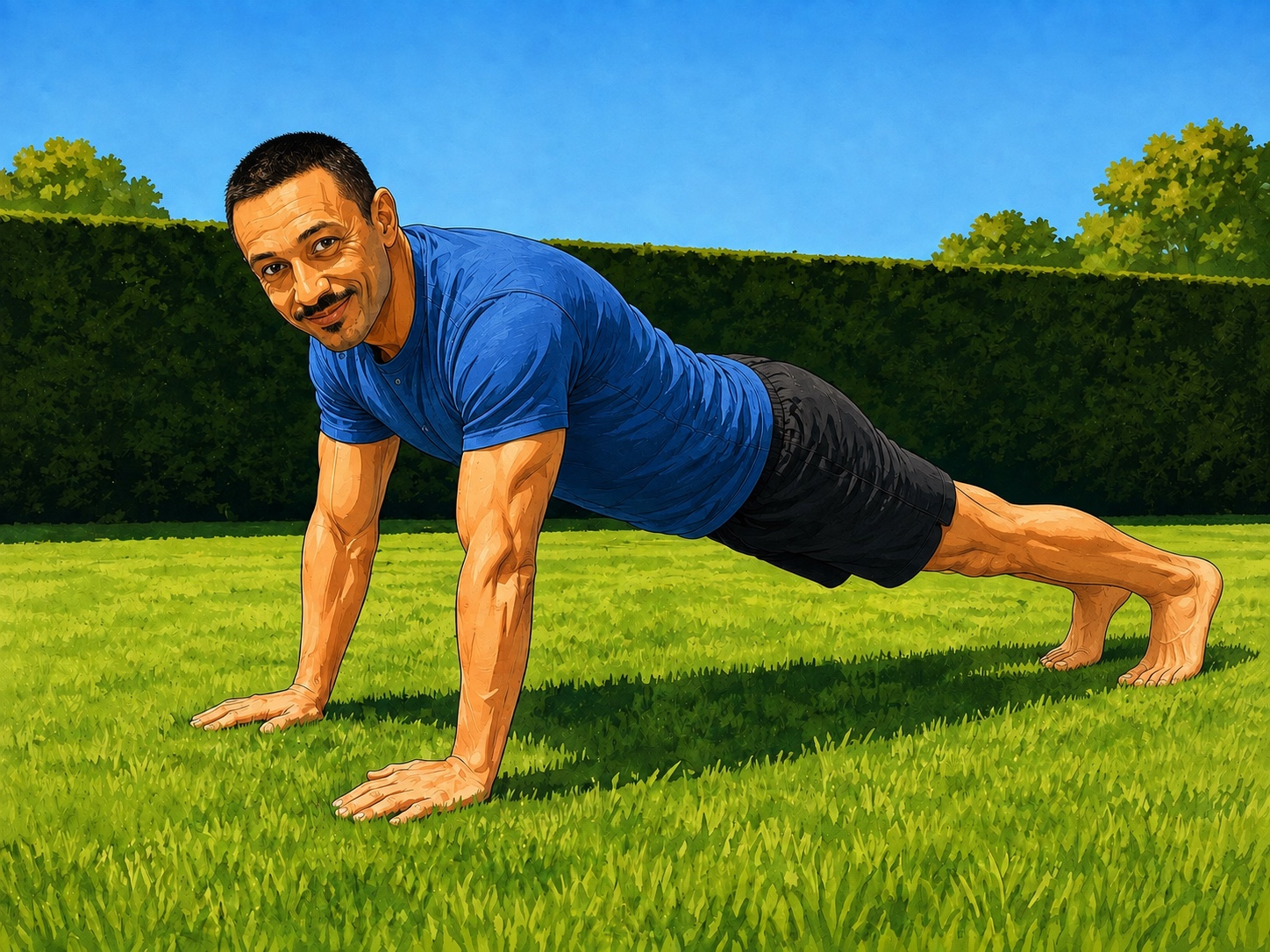
The straight-arm plank is a plank variation performed with the arms extended and the hands on the ground, similar to the top position of a push-up. From the outside, it looks simple: body in one line, arms straight, shoulders active, core engaged. But when the goal is not thirty seconds or one minute, and the hold begins to last ten, fifteen, twenty minutes or more, that simple position becomes a complete endurance challenge.
Straight arms, different demand
In a forearm plank, the elbows and forearms carry the contact with the ground. In a straight-arm plank, the body is supported through the hands, wrists, elbows and shoulders.
That change may look small, but it alters the feeling of the exercise. The shoulders must remain active for the whole hold, the triceps and upper body stay under continuous tension, and the hands can become a major source of pressure as the minutes accumulate.
Why the position matters
The straight-arm plank is not only a core exercise. It is a whole-body position that asks for shoulder stability, locked but not passive elbows, a strong line from head to heels, and enough mental control to avoid wasting energy.
At short durations, the challenge may feel mainly physical. At longer durations, the problem becomes broader: breathing rhythm, attention, discomfort management, surface choice, hand pressure and recovery all start to matter.
Straight-arm plank vs forearm plank
The forearm plank often feels more directly focused on the abdomen and trunk. The straight-arm plank can feel more exposed in the upper body, because the shoulders and hands are carrying the position through a longer lever.
For me, this distinction was decisive. I had already trained the forearm plank and reached twenty-seven minutes. Then I discovered the straight-arm plank, tried it, and found a new question: could this position become the center of a world-record attempt?
The official record target
The straight-arm abdominal plank is recognized by Guinness World Records with separate male and female record titles. The current men's mark is 50 minutes and 4.58 seconds, achieved by Kenneth Travis in Longview, Texas, USA, on June 8, 2026.
That update changes the psychological scale of this project. A target that already felt extreme has moved far beyond the previous thirty-four-minute range. It does not erase the work already done, but it does force a more honest question: what is the right meaning of this journey now?
The female mark is 36 minutes and 2 seconds, held by Aneta Hudson. These numbers are far beyond ordinary fitness targets. That is exactly why this project has to be built slowly: not as a single heroic test, but as a long process of adaptation, reassessment and truth.
How I train it
My training is based on a simple idea: add capacity gradually while recording honestly what happens. Some days are long continuous holds. Other days are repeated sets, such as five blocks of four minutes or four blocks of six minutes, with short recoveries between them.
The journal records more than the numbers. It also records breathing, shaking, numb fingers, soreness, sleep, surfaces, recovery and the mental negotiation that appears when the body wants to stop before the plan is complete.
Why One More Minute exists
One More Minute is my public record of this attempt. It is partly a training log, partly an experiment in endurance, and partly a way to make the invisible part of a goal visible.
If someone searches for straight-arm plank, plank straight arm, plank endurance or plank world record, I hope they find not only a definition, but a real process: the ordinary sessions, the difficult decisions, the recovery days and the slow construction of one more minute.
THE TAKEAWAYThe straight-arm plank is simple in shape but complex in duration. The longer it lasts, the more it becomes a test of shoulders, core, breathing, recovery and the ability to stay calm inside discomfort.
Loading comments…